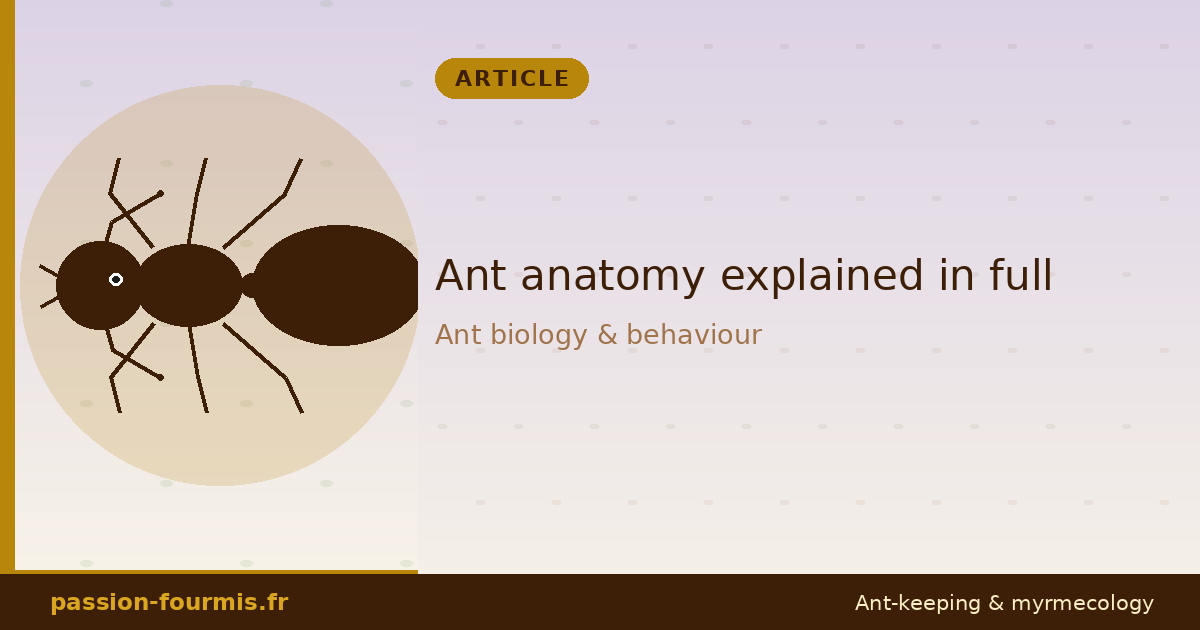
A 5 mm ant is a genuine miniaturised biological machine. Understanding its anatomy helps you appreciate its abilities. Here is a breakdown of the main structures that make up its body.
The 3 main segments
Like all insects, the ant has three distinct segments:
- The head
- The thorax (bears the legs and, in reproductives, the wings)
- The abdomen (digestive, reproductive and defensive organs)
A peculiarity of ants: between the thorax and the abdomen there is an extra, very narrow segment called the petiole. Depending on the species, it can have one or two nodes. It’s an important identification criterion.
The head
The head concentrates most of the sensory organs and the working tools:
The antennae
Elbowed (at a right angle), they are the main sensory organs. They detect pheromones, smells, CO2, humidity and even subtle vibrations. A lost antenna seriously handicaps an ant.
The eyes
Ants have compound eyes on the sides of the head, made of thousands of ommatidia. But their vision is poor: most make out shapes badly and mainly see movement and contrast. Many subterranean species have atrophied eyes.
In addition to the compound eyes, some species have 3 ocelli on top of the head (especially in reproductives), which detect polarised light and help with orientation.
The mandibles
These are the ant’s “hands” and weapons. Their shapes vary enormously by species and role:
- Long, thin mandibles: foraging workers
- Massive pincer-like mandibles: majors and soldiers
- Toothed mandibles: Messor, for crushing seeds
- Snap-jaw mandibles: Odontomachus, closing in a few milliseconds
The thorax
The thorax is made of three fused segments (prothorax, mesothorax, metathorax). It bears:
- The 6 legs (3 pairs), articulated in several segments
- In reproductives (virgin queens and males): 2 pairs of membranous wings, shed by queens after the nuptial flight
Inside the thorax: powerful muscles for locomotion and flight.
When an ant walks, its 6 legs don’t move randomly: it uses an “alternating tripod” pattern. Three legs on the ground (front left, middle right, rear left) form a stable triangle, then the other three step forward. This pattern ensures perfect stability at any speed.
The petiole
This very narrow waist between the thorax and abdomen allows:
- Great flexibility of the gaster (abdomen): the ant can tuck it under its body to sting or defend itself
- Instant distinction from another insect family (wasps also have a wasp waist, but their antenna is straight)
The number of petiole nodes (1 or 2) is used to classify the subfamilies: the Formicinae (Lasius, Camponotus, Formica) have 1 node, the Myrmicinae (Messor, Myrmica, Pheidole) have 2.
The abdomen (gaster)
The abdomen, called the gaster in myrmecology, contains:
- The social crop: a sac where the ant stores nectar to share through trophallaxis
- The digestive tract with its own stomach
- In the queen: the ovaries that produce eggs
- The defensive glands: venom in Myrmicinae (stinger), formic acid in Formicinae
- The heart (dorsal vessel that pumps the haemolymph)
- The tracheae and their openings (spiracles) for breathing
The external skeleton (cuticle)
Like all arthropods, ants have an exoskeleton made of chitin, a tough, waterproof substance. This cuticle is coloured (pigments + structure) and sometimes bears sensory hairs called sensilla.
To grow, larvae moult several times (shed their cuticle). Once adult, the ant no longer grows: its size is final.
The glandular organs
An ant has more than 10 different glands, each producing specific chemicals:
- Mandibular gland (alarm pheromones, antimicrobials)
- Postpharyngeal gland (recognition pheromones, lipids)
- Dufour’s gland (trail pheromones)
- Venom gland (in stinging species)
- Formic acid gland (in Formicinae)
- Tibial and metapleural glands (antimicrobial)
This glandular diversity makes the ant a genuine miniature chemical laboratory.
In summary
A 5 mm ant packs into a tiny body an anatomical organisation of remarkable complexity. Eyes, antennae, mandibles, articulated legs, chemical glands, reproductive organs, a differentiated digestive system, chemical defences: all evolutionary innovations that explain the extraordinary ecological success of this group of insects.
Leave a Reply