
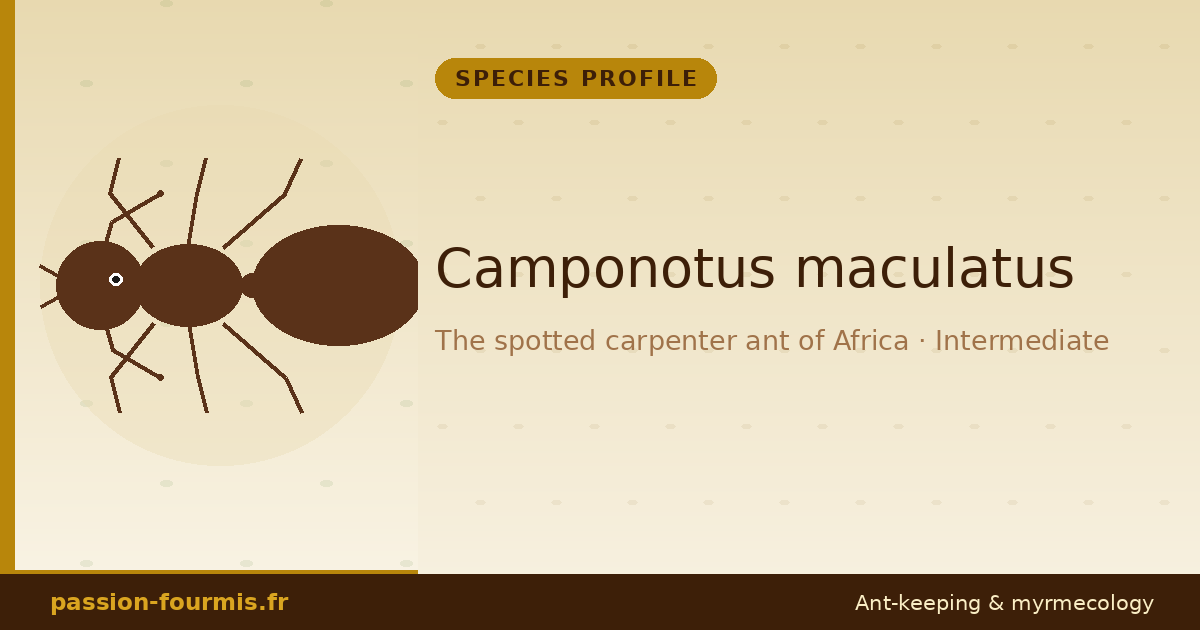
An exotic with a unique look
Camponotus maculatus is a palaeotropical species found across sub-Saharan Africa. Its name (maculatus = spotted) refers to the yellow or cream markings on its abdomen, giving it a distinctive, recognisable look. It’s a species rarely seen in Europe and one that requires tropical conditions.
Like all Camponotus, it’s a largely arboreal and nocturnal species. Indoor keeping suits its temperature preferences well.
Camponotus maculatus is a tropical species: it does not hibernate. Keep it at 25-28°C all year. A prolonged drop below 18°C can kill the colony.
Founding
Sporadic nuptial flights in the rainy season (varying by geographic origin). Founding is claustral, but the test tube must be kept at a constant 26-28°C. The first workers appear in 2-3 months.
Tropical conditions
Keep high humidity (50-70%) and a stable temperature of 26-28°C. A terrarium heat mat or heat cable is often needed in winter, even in a heated home.
Feeding
Camponotus maculatus is very much a sugar-feeder. Favour fresh fruit (banana, mango, papaya where available), sugary solutions and honeydew. Insects are eaten more occasionally.

Terrarium heat mat 20W
Essential to maintain the tropical temperatures of Camponotus maculatus.
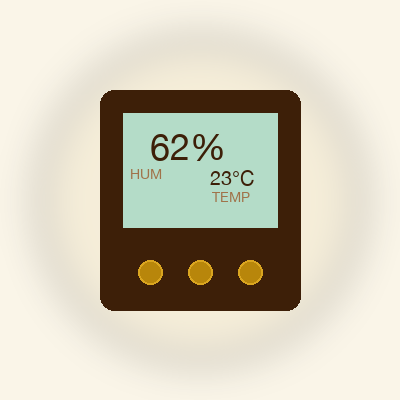
Digital hygrometer / thermometer
To precisely track tropical keeping conditions.
Frequently asked questions
- How big is Camponotus maculatus?
- Queen: 12-15 mm — Workers: 6-12 mm.
- How long does a Camponotus maculatus queen live?
- A Camponotus maculatus queen lives approximately 15-20 years.
- How does Camponotus maculatus found a colony?
- Foundation type: Claustral — Polygynous: No.
- What does Camponotus maculatus eat?
- Diet: Sugars, fruit, insects.
- Does Camponotus maculatus need a diapause (hibernation)?
- Diapause: None (tropical).
- What temperature and humidity does Camponotus maculatus require?
- Temperature: 25-30°C — Humidity: 50-70%.
- How large does a Camponotus maculatus colony grow?
- Colony size: 3,000-8,000.
- Is Camponotus maculatus suitable for beginners?
- Difficulty level: 3/5 (intermediate).
Sources & references
Authoritative references for further reading on Camponotus maculatus:
Leave a Reply