
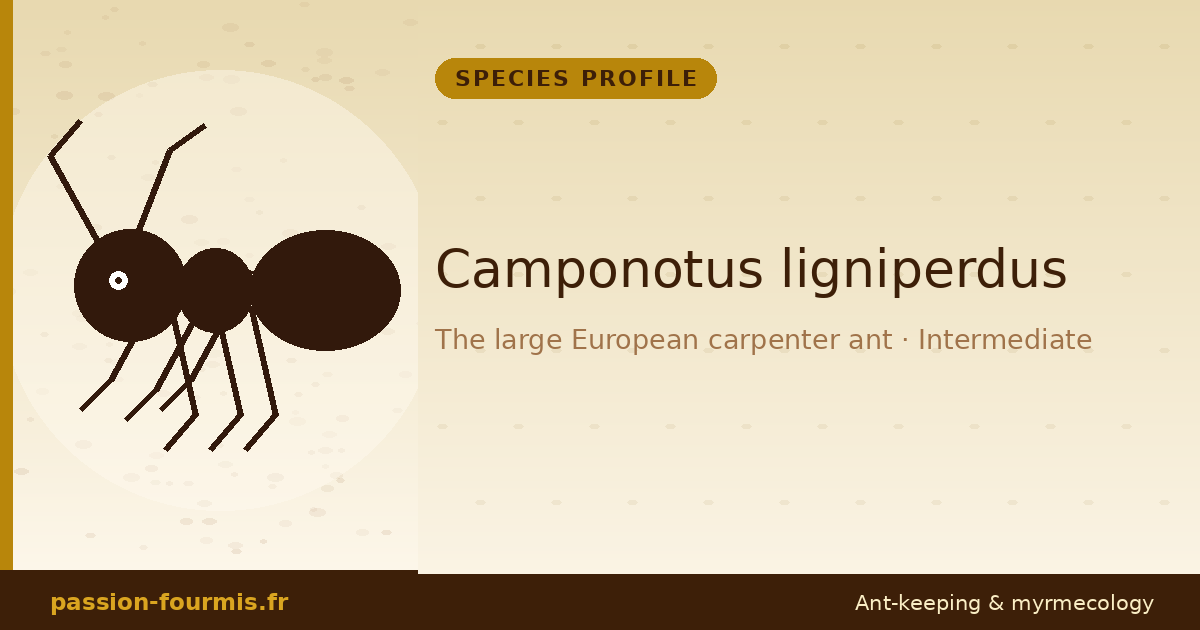
The large European carpenter ant
Camponotus ligniperdus is one of the largest Camponotus in Europe. Bicoloured black and brick-red, its silhouette is immediately recognisable. Like all carpenter ants, it digs its nests in dead wood in woodland or woodland-edge settings.
Polymorphism is marked: workers from 6 mm to 14 mm major soldiers with powerful mandibles. The queen measures 16-18 mm, making it one of the largest European ants.
Like all Camponotus, growth is very slow in the first year: allow 6-12 months for the first workers, and 2-3 years before a hundred. The reward comes afterward: spectacular majors and a magnificent colony.
Behaviour and natural habitat
In the wild, it’s found in old stumps, dead trunks, old timberwork. Colonies are often satellite-based: several nests linked by trails, a few metres apart. The main nest houses the queen and brood; the satellite nests mostly hold workers.
Classic opportunistic feeding: aphid honeydew, dead or live insects, sometimes sugary resins. In captivity, sugar water and thawed fruit flies are enough.
Flights take place in May-June after the first big warm thunderstorms. The winged queens are huge and easy to find on the ground after the flight. It’s the ideal chance to start this species — patient, observable, long-lived (queens live up to 25 years).
Keeping
Temperate, 20-26°C when active, humidity 50-70%. Mandatory hibernation of 4-5 months at 5-10°C. Ytong, plaster or dead-wood nest recommended. Claustral founding: don’t feed the queen before the workers emerge. A standard 16x150mm test tube for founding, transfer to a nest beyond 20 workers.
Frequently asked questions
- How big is Camponotus ligniperdus?
- Queen: 16-18 — Workers: 6-14.
- How long does a Camponotus ligniperdus queen live?
- A Camponotus ligniperdus queen lives approximately 20-25.
- How does Camponotus ligniperdus found a colony?
- Foundation type: Claustral — Polygynous: No.
- What does Camponotus ligniperdus eat?
- Diet: Insects, sugar, honeydew.
- Does Camponotus ligniperdus need a diapause (hibernation)?
- Diapause: Yes (Oct-Mar).
- What temperature and humidity does Camponotus ligniperdus require?
- Temperature: 20-26 — Humidity: 50-70.
- How large does a Camponotus ligniperdus colony grow?
- Colony size: 4,000-10,000.
- Is Camponotus ligniperdus suitable for beginners?
- Difficulty level: 3/5 (intermediate).
Sources & references
Authoritative references for further reading on Camponotus ligniperdus:
Leave a Reply