
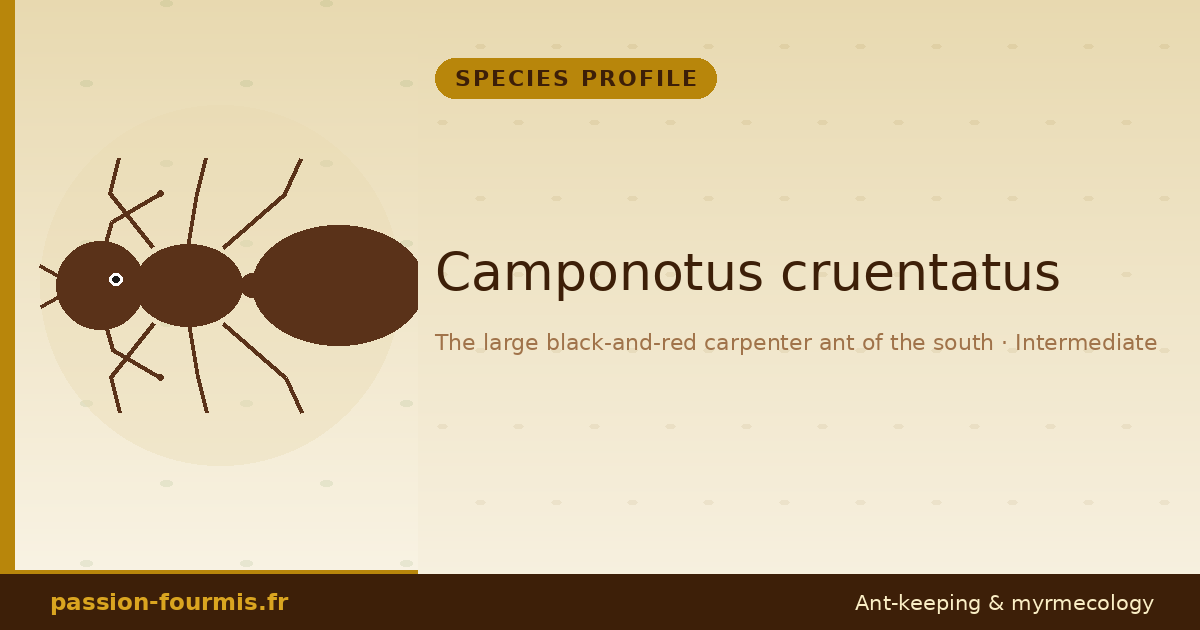
The spectacular Mediterranean carpenter ant
Camponotus cruentatus is one of the most beautiful ants of southern France and the Iberian Peninsula. Its name evokes its typical colour: a black and blood-red body (cruentatus = bloody in Latin). It’s a polymorphic species: workers range from 7 to 15 mm, the majors showing a characteristic large head.
Like all Camponotus, it’s an arboreal and slow ant that doesn’t dig its own galleries but settles in dead wood, under bark or in natural cavities.
The genus Camponotus is one of the most diverse in the world, with more than 1000 species. Carpenter ants are recognisable by their large size, slow gait and tendency to nest in wood. No species in the genus has a stinger: they spray formic acid when threatened.
Slow growth, patience required
Camponotus is known for its very slow growth. The queen lays few eggs and the first workers can take 3 to 5 months to appear. This early patience is rewarded by the colony’s visual beauty later on.
After 5-7 years, a colony can have 1000 to 3000 workers, sometimes more. It’s a species you keep for the long term.
Keeping conditions
Camponotus cruentatus likes warmth (24-28°C in summer) and tolerates cooler temperatures in winter. Moderate humidity (40-60%). Hibernation is essential at 8-12°C for 3-4 months (slightly warmer than a Lasius). Don’t put it in a regular refrigerator.
Feeding
An omnivore especially fond of fresh fruit (pieces of apple, banana), sugary solutions (honeydew, 10% sugar water) and live or dead insects. Don’t overload on proteins: Camponotus is more of a sugar-feeder than average.
Majors have an enormous, almost cubic head, packed with powerful muscles. They defend the nest and break apart tough insects. Seeing the first majors appear (around the 2nd year) is one of the great moments of keeping Camponotus.
Wooden nest for Camponotus
A wooden nest (cedar, beech, oak) recreates the carpenter ant's natural habitat.
Honey sugar water
A ready-to-use solution to feed Camponotus all year round.
Frequently asked questions
- How big is Camponotus cruentatus?
- Queen: 15-18 mm — Workers: 7-15 mm (polymorphic).
- How long does a Camponotus cruentatus queen live?
- A Camponotus cruentatus queen lives approximately 20-25 years.
- How does Camponotus cruentatus found a colony?
- Foundation type: Claustral — Polygynous: No.
- What does Camponotus cruentatus eat?
- Diet: Honeydew, insects, fruit.
- Does Camponotus cruentatus need a diapause (hibernation)?
- Diapause: Yes (3-4 months).
- What temperature and humidity does Camponotus cruentatus require?
- Temperature: 22-28°C — Humidity: 40-60%.
- How large does a Camponotus cruentatus colony grow?
- Colony size: 5,000-10,000.
- Is Camponotus cruentatus suitable for beginners?
- Difficulty level: 3/5 (intermediate).
Sources & references
Authoritative references for further reading on Camponotus cruentatus:
Leave a Reply