
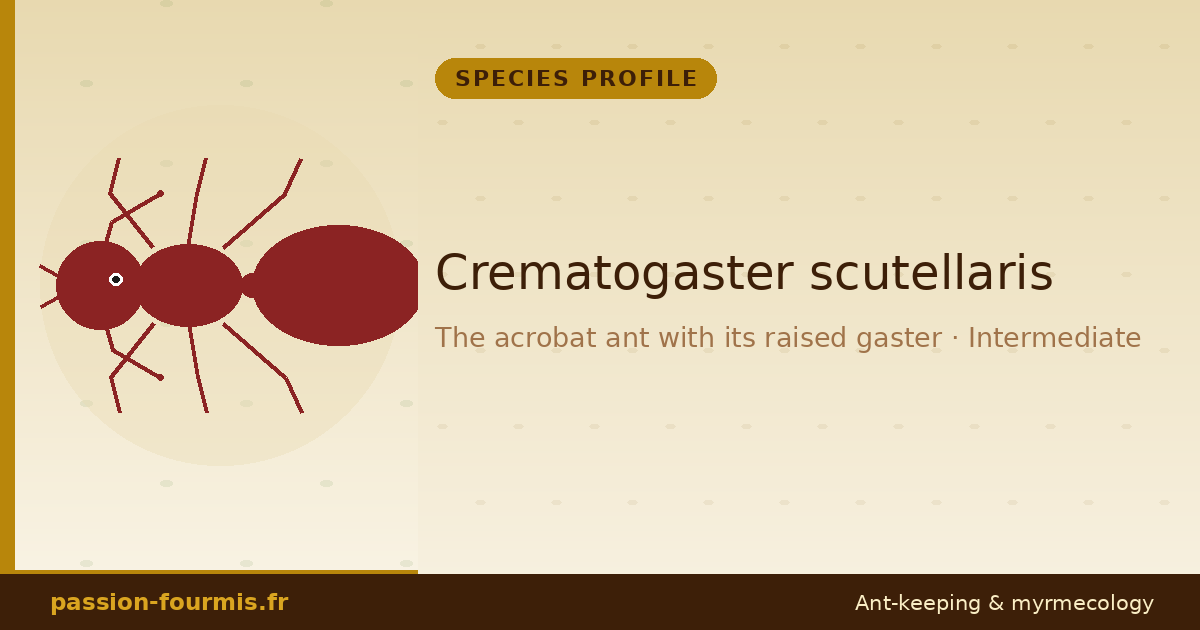
The ant that walks with its rear in the air
Crematogaster scutellaris is one of the most recognisable ants in Europe: its raised gaster (abdomen) is its signature. When it feels threatened, it lifts its gaster upward like a scorpion, ready to spray a defensive substance. Its bright brick-red and black colouring makes it very striking.
An arboreal species, it nests in dead wood, under cork-oak bark, and forages on trees to collect honeydew from aphids and scale insects.
Blow gently on an active colony: the workers immediately raise their gaster as an alert signal. It’s one of the most impressive visual displays of keeping Crematogaster.
Founding
Nuptial flight in autumn (September-October). Claustral founding, 6-10 weeks for the first workers.
Artificial habitat
Recreate its arboreal environment: a wooden nest (cork, cedar) or a plaster nest with decorative branches. The outworld can include vertical elements (branches, bark plates) to observe its climbing abilities.
Conditions
Warmth of 22-27°C, moderate humidity (40-60%), a short winter hibernation (3 months at 8-10°C, not too cold since it’s Mediterranean).
Cork bark plates for terrarium
To set up a Crematogaster nest close to its natural habitat on cork oaks.
Frequently asked questions
- How big is Crematogaster scutellaris?
- Queen: 8-10 mm — Workers: 3-5 mm.
- How long does a Crematogaster scutellaris queen live?
- A Crematogaster scutellaris queen lives approximately 12-18 years.
- How does Crematogaster scutellaris found a colony?
- Foundation type: Claustral — Polygynous: No.
- What does Crematogaster scutellaris eat?
- Diet: Honeydew, insects.
- Does Crematogaster scutellaris need a diapause (hibernation)?
- Diapause: Yes (3 months).
- What temperature and humidity does Crematogaster scutellaris require?
- Temperature: 22-27°C — Humidity: 40-60%.
- How large does a Crematogaster scutellaris colony grow?
- Colony size: 3,000-8,000.
- Is Crematogaster scutellaris suitable for beginners?
- Difficulty level: 3/5 (intermediate).
Sources & references
Authoritative references for further reading on Crematogaster scutellaris:
Leave a Reply