
Description and identification
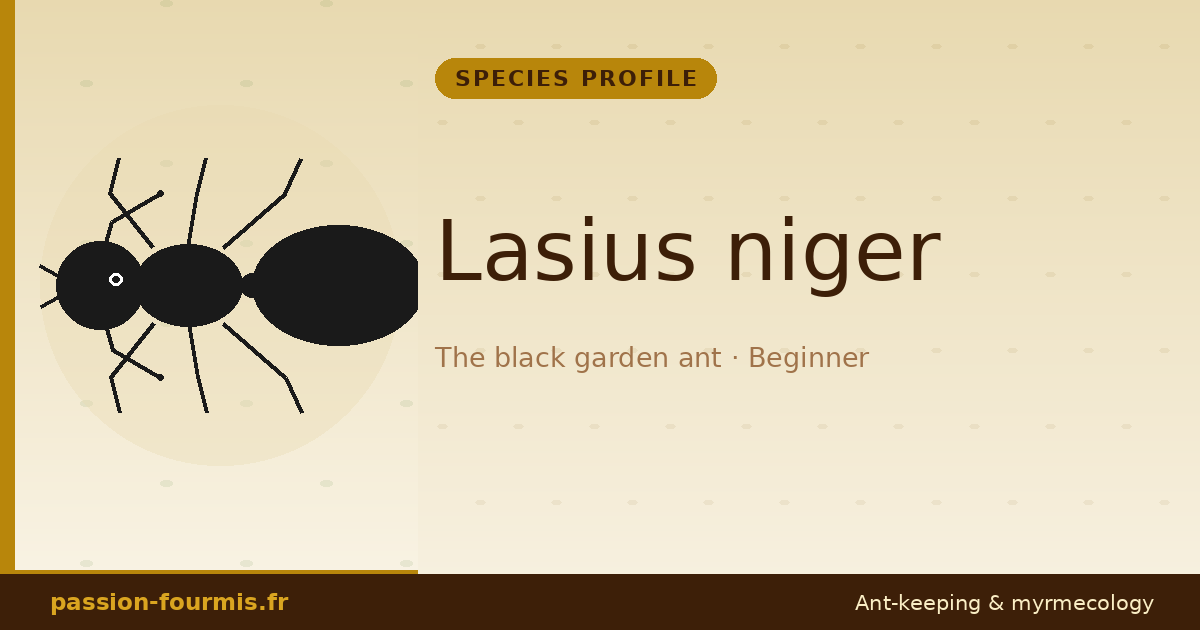
Lasius niger, known as the black garden ant, is one of the most common species in Europe. You can recognise it by its uniformly matte-black colour and its modest size (3 to 5 mm for workers). It’s probably the ant you most often come across on pavements and in gardens. Its hardiness and ease of keeping make it the number-one choice to start out in myrmecology.
The queen, much larger (8-10 mm), has a broadened thorax housing the wing muscles. After the nuptial flight (usually in July-August after a thunderstorm), she sheds her wings and looks for a sheltered spot to found her colony.
Look on the ground after a summer thunderstorm. The freshly mated queen is black, shiny, about 8 mm, and walks on the ground. Her wings have often already been torn off. Collect her in a clean test tube with a water reserve and keep her in the dark.
Founding and starting the colony
Founding is claustral: the queen no longer leaves the test tube and lives off her body reserves (abdominal fat, reabsorbed wing muscles) while raising the first workers. Allow 1 to 2 months between the first eggs and the first workers (the nanitics). Whatever you do, don’t open the tube or provide any food during this phase: stress can kill the queen.
The first workers emerge around September-October. That’s when you should start offering a little sugar water (diluted honey) and small dead insects (fruit flies, butterfly wings).
Keeping conditions
Lasius niger tolerates a wide temperature range (18 to 28°C) and prefers moderate humidity. Hibernation is mandatory every year, from late November to February, ideally between 4 and 8°C (a cool corner of the cellar or the fridge crisper drawer works). Without hibernation, the queen prematurely exhausts her resources and the colony declines.
Growth and colony size
A Lasius niger colony can reach 5,000 to 10,000 workers after 5 to 7 years, sometimes more. In the early years, growth is slow: 50 to 200 workers by the end of the first season. Be patient.
Don’t try to move your queen into a plaster nest from the start. She needs the test tube for at least the whole founding phase, and ideally up to 30-50 workers. Too much space = stress and a risk of losing the queen.
Recommended gear to get started

Glass test tubes 16x150mm
The ideal format for founding. Get a pack of at least 10 tubes for the future queens you'll find.
Cotton wool
To make the wet plug that holds water in the tube. Choose untreated cotton.
Soft plastic tweezers
To handle the queen without injuring her during the transfer.
Frequently asked questions
- How big is Lasius niger?
- Queen: 8-10 mm — Workers: 3-5 mm.
- How long does a Lasius niger queen live?
- A Lasius niger queen lives approximately 15-25 years.
- How does Lasius niger found a colony?
- Foundation type: Claustral — Polygynous: No.
- What does Lasius niger eat?
- Diet: Honeydew, insects, sugars.
- Does Lasius niger need a diapause (hibernation)?
- Diapause: Yes (5°C, 3 months).
- What temperature and humidity does Lasius niger require?
- Temperature: 22-26°C — Humidity: 40-60%.
- How large does a Lasius niger colony grow?
- Colony size: 10,000+ workers.
- Is Lasius niger suitable for beginners?
- Difficulty level: 1/5 (beginner).
Sources & references
Authoritative references for further reading on Lasius niger:
Leave a Reply