
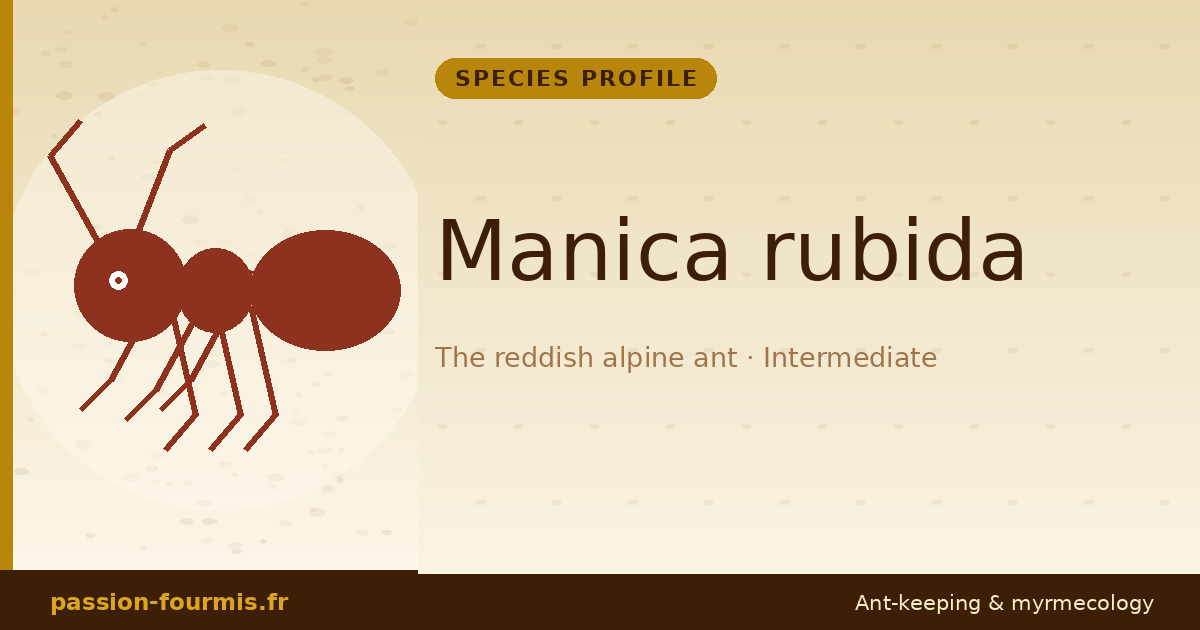
The reddish alpine ant
Manica rubida is a myrmicine uncommon in captivity but fascinating. Hardy, orange-red, with a painful sting (one of the most notable among European ants), it lives in high-altitude grasslands and rocky margins of the Massif Central, the Alps, and Eastern Europe.
Its defensive behaviour is very pronounced: aggressive sentinels, rapid recruitment on alarm, a sting as soon as it feels threatened. Handle it only with gloves or long tweezers.
Manica rubida is one of the few European ants whose sting really leaves a mark. Comparable to a wasp sting, with pain lasting 30 minutes. Not dangerous, but be careful when handling. Tweezers and gloves advised. A serious escape barrier too, since it climbs fast.
Semi-claustral founding
A notable quirk: the queen can go out to look for food during founding (semi-claustral). In captivity, offering it a small insect (a fruit fly) every 2 weeks during the first months speeds up its start. Without that, it may stall and stagnate.
Wild colonies are small (500 to 2,000 workers), often polygynous in the mountains: several queens share the same nest to withstand harsh winters. A rare and fascinating social behaviour to observe.
At altitude, M. rubida practises facultative polygyny: 2-5 queens coexist in the same nest. It’s an adaptation to cold conditions. In captivity, you can attempt a polygynous colony — a rare behaviour to observe among European species.
Keeping
Cool temperate: 18-22°C when active, tolerates above 25°C poorly. Humidity 60-70%. Mandatory hibernation of 4-5 months at 5-10°C. Classic feeding. A plaster or Ytong nest with cool galleries. An interesting intermediate species for anyone wanting to move beyond the classics.
Frequently asked questions
- How big is Manica rubida?
- Queen: 10-12 — Workers: 5-8.
- How long does a Manica rubida queen live?
- A Manica rubida queen lives approximately 10-15.
- How does Manica rubida found a colony?
- Foundation type: Semi-claustral — Polygynous: Variable.
- What does Manica rubida eat?
- Diet: Insects, sugar.
- Does Manica rubida need a diapause (hibernation)?
- Diapause: Yes (Oct-Mar).
- What temperature and humidity does Manica rubida require?
- Temperature: 18-22 — Humidity: 60-70.
- How large does a Manica rubida colony grow?
- Colony size: 500-2,000.
- Is Manica rubida suitable for beginners?
- Difficulty level: 3/5 (intermediate).
Sources & references
Authoritative references for further reading on Manica rubida:
Leave a Reply