Beginner

The outworld: connections and escape barriers
The outworld is where your ants forage. How to design it effectively, with no escapes.
Ytong (aerated concrete) nest: carving techniques
Ytong has become the go-to material of myrmecology. Here’s how to carve your nest step by step.
Building a simple plaster ant nest
The classic nest: easy to make, cheap, ideal for most species. A complete tutorial.
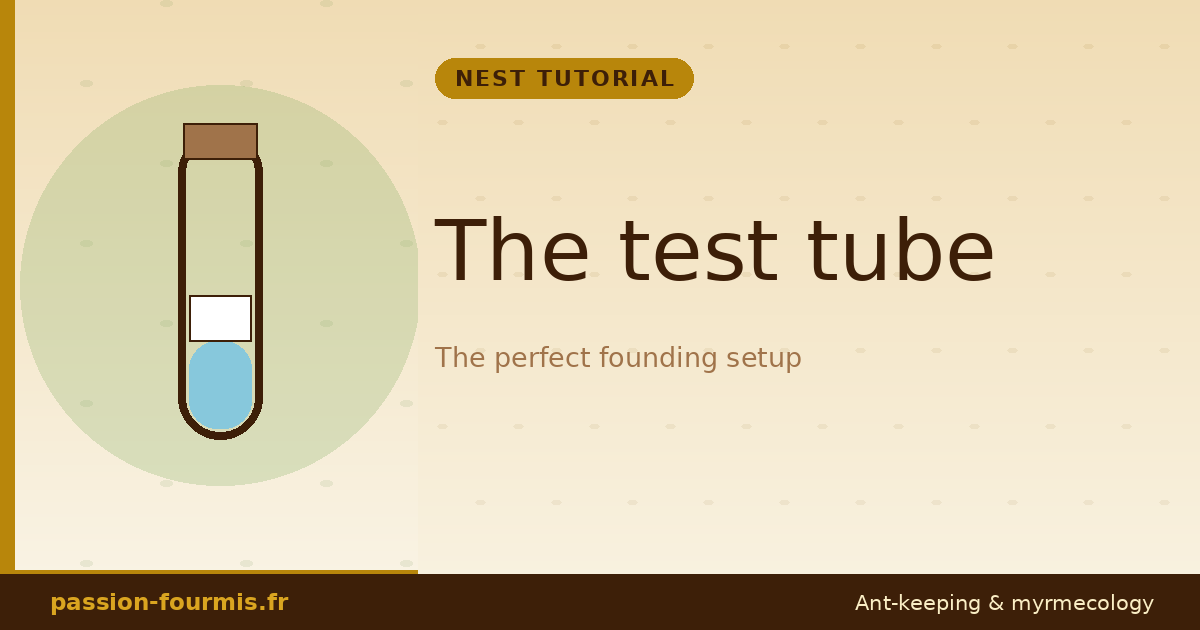
The test tube: the perfect founding setup
How to prepare a test tube to house a queen. The foolproof technique, step by step.
10 beginner myrmecologist mistakes to avoid
The classic pitfalls when starting out in ant keeping. Learn from others’ mistakes before making them yourself.
Managing the humidity of an ant nest
Why humidity is crucial, how to measure it, how to maintain it. Everything about this essential question.
Feeding ants: water, sugars, proteins
What do our ants eat? The complete feeding guide: sugars, proteins, water, frequencies.
The annual cycle of an ant colony
Hibernation, founding, growth, reproduction: understand a colony’s seasons to manage it well.
Catching a queen ant in the wild: a practical guide
When, where and how to find a mated queen in the wild. The right techniques so you don’t stress her.
How to choose your first ant species?
Selection criteria for a first colony: difficulty, size, behaviour, climate needs. Our methodology.
Starting your ant colony: the complete guide
Everything you need to know to start keeping ants: choosing a species, gear, founding, first steps.
Lasius niger
The black garden ant, perfect for beginners. Hardy, versatile and easy to keep.
Messor barbarus
The harvester ant, granivorous and spectacular. A fascinating species for motivated beginners.
Formica fusca
The silky ant, a peaceful woodland species. Calm, easy to keep, and remarkably numerous.
Myrmica rubra
The European red ant, small but stinging. A beginner-friendly polygynous species.
Lasius flavus
The yellow meadow ant, subterranean and discreet. Ideal to observe an underground colony.
Lasius emarginatus
The wall ant, heat-loving and bicoloured (reddish thorax). Very active in urban settings.
Tetramorium caespitum
The pavement ant, tiny but voracious. Ideal to observe a large colony in little space.
Aphaenogaster senilis
The long-legged Aphaenogaster, elegant and active. An emblematic species of the western Mediterranean.
Messor structor
A continental harvester ant, smaller than M. barbarus but suited to a temperate climate.